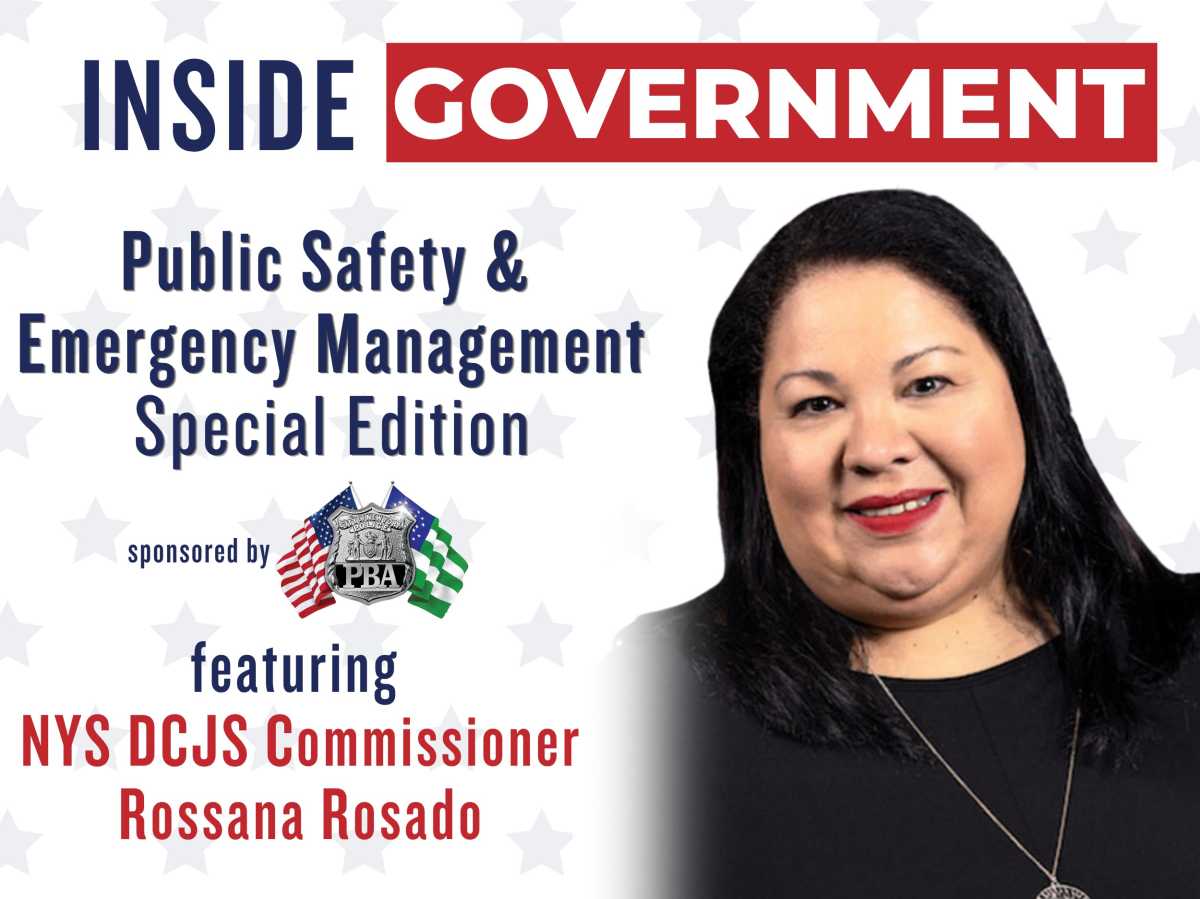
Inside Government: Public Safety & Emergency Management, sponsored by the New York City Police Benevolent Association, is PoliticsNY’s latest special edition featuring the government officials shaping public safety and emergency management services and policy in New York. Today’s Q&A is with New York State Division of Criminal Justice Service (DCJS) Commissioner Rossana Rosado. The NYS DCJS partners with law enforcement, community organizations, and local governments to support all facets of the state’s criminal justice system from crime prevention and diversion to rehabilitation and re-entry.
Can you briefly describe your main responsibilities as NYS DCJS commissioner for those unfamiliar with your role?
My DCJS team and I partner with other state agencies to implement Governor Kathy Hochul’s comprehensive strategies to build safer and stronger communities for all New Yorkers. We provide funding, training, and critical information and data to law enforcement, criminal justice, and community partners statewide. Our partners include thousands of police, prosecutors, crime labs, probation departments, defense attorneys, and community organizations that prevent crime, support victims, and help justice-involved individuals returning to their communities.
How does the NYS DCJS work to prevent crime and keep New Yorkers safe?
We administer $850 million in annual grants, allowing our partners to implement evidence-based strategies to reduce, solve, and prevent crime; more effectively prosecute crimes and protect the rights of those accused; and provide programs and opportunities for young people and families. We provide critical system support: ensuring the accuracy of the state’s criminal history records, maintaining the state’s fingerprint database, and helping oversee the state’s DNA Databank. This is just a snapshot of our work.
What are some recent initiatives that your division has implemented?
Record-level funding secured by Governor Hochul with support from the Legislature has allowed DCJS to expand its Gun Involved Violence Elimination initiative, implement the Statewide Targeted Response to Intimate Partner Violence program, create Project RISE to support youth programming and prevent justice-system involvement, and establish a New York City Crime Analysis Center, the eleventh in our statewide network. Gun violence is at all-time lows and crime is trending down statewide.
How has your career up until your appointment prepared you for your role as commissioner?
Joining DCJS after serving as New York’s secretary of state was the culmination of my professional and personal passions. It is my dream job. My state service is informed by my previous work: I spent 30 years as a media executive and award-winning producer. The individuals I met and stories I shared shaped my interest in the criminal justice system, and a desire to ensure that it is fair and equitable for all New Yorkers.
From the NYC PBA: More than 6,000 NYPD members have quit before reaching retirement in the past five years, which is more than double the previous five-year rate. How does this attrition affect public safety, and should government do more, like offering pay raises or other incentives, to keep frontline workers on the job
Recruitment and retention require a multifaceted approach that reflects the needs of individual communities. What works in New York City may not work in Newburgh or Niagara Falls. At DCJS, it’s our privilege to convene our local partners and facilitate their engagement with other state agencies to find solutions to common problems. I welcome the opportunity to explore how we can help agencies keep dedicated public servants and attract new professionals to the field.